Search
Rivet nuts provide a reliable method for creating strong threaded fastening points in thin sheet materials where traditional fastening methods are difficult to apply. By combining the functions of a rivet and a threaded nut, they allow manufacturers to install reusable threads into panels, tubes, and lightweight structures without requiring access to the rear side of the assembly.
For industries such as automotive manufacturing, electrical equipment, industrial enclosures, machinery production, and metal fabrication, rivet nuts offer an efficient alternative to welding nuts or tapping thin materials directly. They improve assembly flexibility while maintaining strong mechanical performance under vibration, repeated installation, and demanding operating conditions.
The correct selection of rivet nuts depends on several factors, including base material thickness, load requirements, corrosion conditions, thread specifications, and installation methods. Understanding these factors helps engineers and purchasing teams select fastening solutions that deliver long-term reliability.
A rivet nut, also known as a threaded insert or blind threaded insert, is a mechanical fastener designed to create an internal threaded hole in materials that are too thin to support conventional threading. Unlike standard nuts that require access from both sides, rivet nuts can be installed from only one side of the workpiece.
During installation, the rivet nut is inserted into a prepared hole. A special installation tool pulls the threaded mandrel, causing the body of the insert to deform and expand behind the sheet material. This deformation creates a strong mechanical lock between the fastener and the base material.
Once installed, the rivet nut provides a permanent threaded connection that allows screws or bolts to be installed and removed multiple times without damaging the surrounding material.
The installation process usually includes four main steps:
Preparing a correctly sized mounting hole in the sheet material
Placing the rivet nut into the hole
Using a manual, pneumatic, or hydraulic installation tool to expand the insert
Installing the matching screw or bolt into the newly created thread
This installation method makes rivet nuts especially useful for applications where welding is unsuitable or where internal access is limited.
Thin sheet materials create unique fastening challenges because they often lack sufficient thickness for direct threading. Increasing material thickness can add weight and cost, while welding operations may introduce heat distortion or require additional processing steps.
Rivet nuts solve these problems by providing strong threaded connections without changing the original structure of the material. By installing rivet nuts, manufacturers can create durable fastening points in thin panels while maintaining lightweight designs and efficient assembly processes.
One of the biggest advantages of rivet nuts is their ability to provide reliable internal threads in materials with limited thickness. This makes them suitable for aluminum sheets, steel panels, composite materials, and other lightweight structures.
Common applications include:
Electrical cabinets and control panels
Automotive body components
Industrial equipment covers
Machine housings
Metal furniture assemblies
Electronic equipment frames
Many industrial structures have enclosed sections where workers cannot access the rear side of the material. Traditional nuts and bolts may require additional assembly components or complicated installation procedures.
Because rivet nuts are installed from one side, they simplify manufacturing processes and reduce assembly time. This advantage is particularly important for closed profiles, tubular structures, and finished assemblies.
Unlike permanent fastening methods such as welding, rivet nuts allow components to be removed and reinstalled during maintenance operations. The internal thread remains available for future fastening requirements, making them suitable for products requiring serviceability.
Rivet nuts are available in various designs to meet different mechanical requirements. The correct type depends on factors such as torque resistance, installation environment, material thickness, and expected loading conditions.
Round body rivet nuts are commonly used for general fastening applications. Their cylindrical design allows easy installation and compatibility with standard drilled holes.
They are frequently used in:
Sheet metal fabrication
Equipment manufacturing
General industrial assemblies
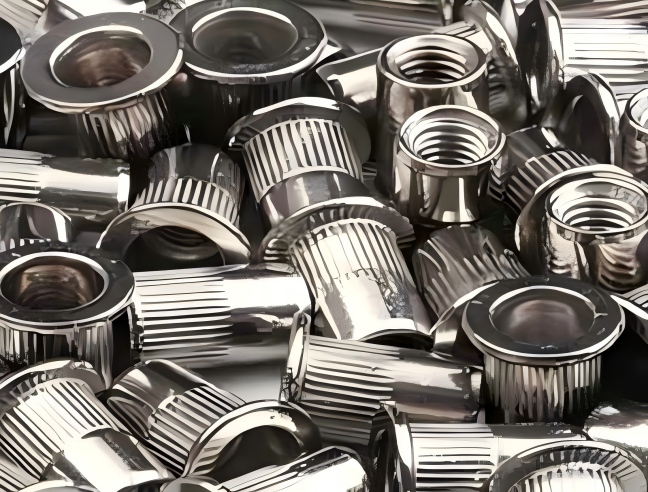
Knurled rivet nuts feature an external textured surface that improves grip between the insert and the parent material. The knurled structure helps reduce rotation during screw installation, especially when used in softer materials.
They are often selected for:
Aluminum panels
Plastic components
Lightweight assemblies
Hexagonal rivet nuts provide improved anti-rotation performance because their external shape prevents the insert from spinning inside the mounting hole.
They are suitable for applications requiring higher torque resistance, including machinery, automotive parts, and heavy-duty equipment.
Material selection directly affects the strength, corrosion resistance, and service life of rivet nuts. Different industrial environments require different material characteristics.
| Material | Advantages | Typical Applications |
|---|---|---|
| Carbon Steel | High strength and economical performance | General industrial equipment and indoor applications |
| Stainless Steel | Excellent corrosion resistance and durability | Outdoor equipment, chemical environments, food processing systems |
| Aluminum | Lightweight and corrosion resistant | Aerospace components and lightweight structures |
For applications exposed to moisture, chemicals, or outdoor environments, stainless steel rivet nuts are often preferred because they provide better corrosion resistance and longer service performance.
Selecting the correct rivet nut requires evaluating the complete fastening environment rather than only considering thread size. Engineers should review material thickness, installation conditions, expected loads, and operating environment before making a decision.
Every rivet nut has a specific grip range that determines the acceptable thickness of the material being joined. Choosing an insert outside the recommended range may result in insufficient expansion or reduced connection strength.
Important considerations include:
Sheet thickness range
Hole diameter requirements
Thread size compatibility
Installation equipment availability
Thread selection is another important factor affecting rivet nut performance. The thread size should match the required load capacity, fastening components, and application requirements.
Common thread considerations include:
Metric or imperial thread standards
Thread pitch requirements
Screw compatibility
Required tightening torque
Using properly selected threaded components helps prevent thread damage and ensures stable fastening performance throughout the product lifecycle.
Proper installation is essential to achieving the designed strength of a rivet nut connection. Even a high-quality insert may fail if the installation process is incorrect.
Rivet nuts can be installed using different tools depending on production requirements and application volume.
| Installation Method | Features | Typical Applications |
|---|---|---|
| Manual Installation Tools | Suitable for low-volume production and maintenance work | Repair operations and small assemblies |
| Pneumatic Installation Tools | Improves installation speed and consistency | Manufacturing production lines |
| Hydraulic Installation Tools | Provides accurate force control for heavy-duty applications | Industrial equipment and high-volume production |
The mounting hole size directly affects the performance of a rivet nut. An oversized hole may reduce holding strength, while an undersized hole may prevent proper installation.
Before installation, manufacturers should confirm:
Correct drilling diameter
Clean hole surface
Suitable material thickness
Proper alignment between components
Excessive installation force can deform the rivet nut incorrectly and damage the surrounding sheet material. Controlled installation ensures the insert expands properly while maintaining the designed mechanical strength.
Both rivet nuts and weld nuts are used to create threaded fastening points, but they are suitable for different manufacturing requirements.
| Comparison | Rivet Nuts | Weld Nuts |
|---|---|---|
| Installation Method | Mechanical installation without welding | Requires welding process |
| Heat Impact | No heat distortion | Possible heat-related material changes |
| Access Requirement | One-side installation | Usually requires access during welding |
| Maintenance | Easy replacement and repair | Permanent attachment |
| Suitable Materials | Thin sheets, aluminum, composites | Mainly weldable metals |
For lightweight structures and applications where welding is impractical, rivet nuts provide a more flexible and efficient fastening solution.
Rivet nuts are widely used across multiple industries because they provide strong threaded connections while maintaining lightweight and efficient designs.
Automotive manufacturers use rivet nuts for interior panels, body components, brackets, and lightweight assemblies. They allow designers to reduce weight while maintaining reliable fastening performance.
Electrical equipment manufacturers often require secure threaded connections in thin metal enclosures. Rivet nuts provide mounting points for covers, panels, and internal components.
Weight reduction is a key consideration in aerospace and transportation industries. Lightweight rivet nut solutions help create strong connections without adding unnecessary material.
Machinery manufacturers use rivet nuts for equipment covers, protective panels, and modular components that require repeated assembly and maintenance.
Reliable fastening performance depends not only on product quality but also on supplier expertise, manufacturing capability, and quality control processes.
Chinbefast provides industrial fastening solutions for global customers, supporting applications across manufacturing, construction, machinery, and industrial assembly sectors.
The company focuses on:
Consistent product quality and dimensional accuracy
Wide selection of industrial fastening products
Support for customized specifications
Professional technical communication
Reliable supply capability for global projects
In addition to rivet nut solutions, Chinbefast supplies other fastening components such as hex bolts for industrial applications requiring secure mechanical connections and reliable assembly performance.
For manufacturers looking to improve sheet material assembly efficiency, selecting suitable threaded inserts can provide stronger fastening points while reducing production complexity.
Rivet nuts are used to create threaded fastening points in thin materials where traditional nuts or tapped threads are not practical. They are commonly used in sheet metal panels, automotive components, electrical enclosures, and industrial equipment.
Yes. One of the main advantages of rivet nuts is that they can be installed from one side of the workpiece, making them suitable for closed structures and limited-access applications.
Rivet nuts can be used with various materials including steel, stainless steel, aluminum, and composite panels. The correct material should be selected according to strength requirements and environmental conditions.
In thin sheet materials, rivet nuts often provide stronger and more reliable threads than directly tapping the base material because they add a dedicated threaded insert with better load distribution.
Selection depends on sheet thickness, required thread size, installation method, load requirements, and operating conditions. Manufacturers should evaluate these factors before choosing a rivet nut specification.
Yes. One of the key advantages of rivet nuts is that they provide reusable threads, allowing screws or bolts to be removed and installed multiple times during maintenance or product servicing.
Rivet nuts provide an effective and flexible threaded fastening solution for sheet materials where traditional fastening methods are limited. Their ability to create strong reusable threads without welding makes them valuable for industries requiring lightweight structures, efficient assembly, and reliable mechanical performance.
From automotive components and electrical enclosures to industrial machinery and transportation equipment, choosing the correct rivet nut type, material, and installation method is essential for achieving long-term fastening reliability.
With extensive experience in industrial fasteners, Chinbefast continues to provide dependable fastening solutions that help manufacturers improve assembly efficiency and product performance. By combining quality manufacturing, technical support, and customized solutions, Chinbefast supports customers worldwide with reliable fastening products.

 English