Search
In mass furniture production, connector choice isn't a small engineering detail—it's a hidden profit lever. One wrong fastener quietly creates a chain reaction: split panels on the line, rework at packaging, wobble complaints after delivery, and returns that erase margin.
This guide compares confirmat screws with cam-and-bolt systems so you can choose the connector that protects cycle time, strength, and field reliability—especially when you're sourcing at scale from confirmat screws suppliers.
Confirmat screws are specialty fasteners engineered specifically for joining particleboard, MDF, and other engineered wood panels. Unlike standard wood screws, they feature a coarse, stepped thread profile and a larger core diameter designed to grip low-density composite materials without pulling out or splitting the substrate.
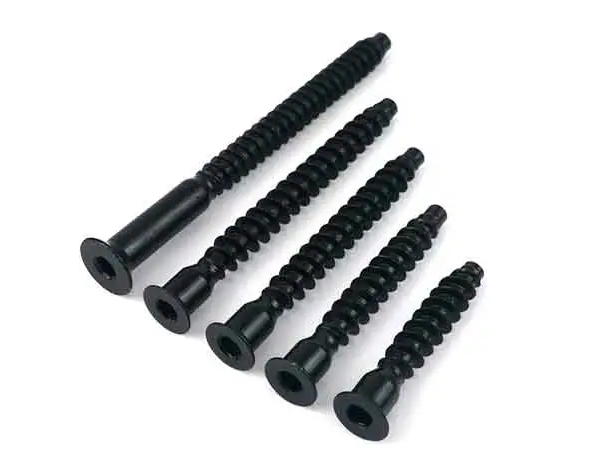
Typical use cases include:
Cabinet carcass assembly (kitchen, bathroom, office)
Flat-pack and knock-down (KD) furniture frames
Shelving units and case goods
Wardrobe and storage system construction
Where they outperform general wood screws: the thread geometry creates a mechanical interlock in particleboard fiber that a standard screw cannot replicate. On a production line, that translates to repeatable joint strength joint after joint—without glue, clamps, or extended cure time. For factory-assembled carcasses, that repeatability is the core value proposition.
The confirmat profile uses a wide, coarse thread with a defined root diameter. When driven into a pre-drilled pilot hole in particleboard or MDF, the thread displaces and compresses the surrounding fiber rather than cutting through it. This compression zone is what delivers pull-out resistance values significantly higher than a standard screw in the same substrate.
Core diameter matters too: a larger core resists bending under racking loads, keeping cabinet frames square under load.
Correct pilot hole diameter and depth are non-negotiable. Too small: panel splits at the edge or face. Too large: thread engagement drops and pull-out resistance falls. The standard approach is a stepped pilot—narrow shaft bore matched to the screw shank, wider counterbore matched to the head—drilled with a dedicated confirmat bit in one pass.
Getting this right eliminates the most common line failure: edge splitting on thin or low-density panels.
On automated or semi-automated lines, three variables drive quality deviation:
Torque consistency: over-torque strips the fiber; under-torque leaves the joint loose
Bit wear: worn Pozi or hex bits cause drive slippage and head damage at high cycle counts
Operator variability: on manual stations, set torque drivers and bit replacement intervals are the practical controls
Before sourcing from confirmat screws suppliers, lock down:
Diameter and length: matched to panel thickness and joint overlap (common: 7×50mm, 7×70mm)
Head style: flat countersunk for flush seating; confirm head diameter fits your counterbore
Drive type: Pozi or hex (hex preferred for automation—better torque transfer, less cam-out)
Thread form: confirm the thread profile matches your pilot hole tooling specification
Mixing specs mid-production is a common source of inconsistent joint quality.
| Option | Best For | Watch Point |
|---|---|---|
| Carbon steel + zinc plating | Standard indoor furniture | Check plating thickness for sea freight |
| Yellow zinc (dichromate) | Higher corrosion resistance in humid storage | RoHS compliance if EU market |
| Stainless steel | Outdoor or high-humidity environments | Higher cost, confirm drive hardness |
Plating consistency matters for confirmat screws suppliers evaluation: thin or patchy plating causes rust in warehouse storage and container shipments, which creates line-feed problems and customer complaints.
Head failure and drive stripping both trace back to hardness. Under-hardened screws deform at the drive recess before the joint is fully seated. Specify a hardness range (typically HRC 28–34 for carbon steel confirmat) and request verification data from the supplier.
Dimensional tolerance on shank diameter and thread pitch directly affects pilot hole fit. Loose tolerances across lots mean the same pilot drill produces variable engagement—inconsistent pull-out, inconsistent torque feel on the line.
For kitting and line feeding, miscounted boxes create stoppages. Require weight-based count verification or exact count packaging, and confirm the packaging format (bulk bag, box, taped strip) suits your feeding method before locking in supply.
Dimensional inspection report per lot
Material certificate (chemistry, hardness)
Salt spray test results if corrosion resistance is specified
Sample approval with pull-out and torque data before mass order
Defect response and containment procedure
Use this matrix to align connector choice with your production reality before the comparison below.
| Criteria | Confirmat Screws | Cam & Bolt | Dowel + Glue |
|---|---|---|---|
| Assembly speed (factory) | Fast | Moderate | Slow (cure time) |
| End-user assembly | Not typical | Designed for it | Difficult |
| Automation fit | Good | Moderate | Low |
| Joint rigidity | High | Moderate | Very high |
| KD / disassembly | Limited | Excellent | Not suitable |
| Tolerance sensitivity | Medium | High | High |
| Visible hardware | Yes (head visible) | Concealed | Concealed |
| Cost-in-use | Low | Medium–High | Medium |
Confirmat screws win on factory takt time. One drilled hole, one driven screw, joint complete. Cam-and-bolt requires two-part hardware insertion plus cam rotation—more steps, more room for assembly error on the line or in the customer's living room. Dowels with glue require clamp time and curing before the joint can take load.
For carcass racking resistance, confirmat screws in properly drilled particleboard/MDF outperform cam-and-bolt under continuous load. Cam-and-bolt joints are designed for convenient assembly and disassembly, not maximum rigidity. Dowel-and-glue joints are the strongest—but eliminate KD flexibility.
Cam-and-bolt wins here: the cam is concealed inside the panel, with only a small cap visible. Confirmat screws heads sit on the surface and require a cover cap for finished visible faces. If interior carcasses are never seen (inside a cabinet), this is irrelevant. For exposed joints, cover caps or design accommodation are needed.
Cam-and-bolt systems are sensitive to hole positioning accuracy—misaligned holes prevent cam engagement. Confirmat screws are more forgiving on positioning but sensitive to pilot hole diameter. Dowel joints require the tightest positional tolerance of the three.
Confirmat screws have the lowest hardware cost. Cam-and-bolt sets (cam + bolt + sometimes a dowel) cost more per joint and require more SKUs to manage. Factor in drilling cost, assembly labor, and rework/return rates—not just unit hardware price.
Confirmat screws: factory-assembled carcasses where rigidity, speed, and simple hardware management matter
Cam-and-bolt: flat-pack consumer assembly, concealed hardware requirements, repeat disassembly expected
Dowels + glue: maximum rigidity, glued permanent joints, high process control available
Higher pull-out strength in particleboard and MDF vs standard screws
Rigid carcass joints reduce wobble complaints and return rates
Single-SKU hardware simplifies inventory vs multi-part cam sets
Fast, automation-compatible assembly supports high takt rates
| Challenge | Root Cause | Fix |
|---|---|---|
| Panel splitting | Wrong pilot diameter or insufficient edge distance | Standardize stepped pilot bit; enforce minimum edge distance |
| Stripped drive recess | Under-hardened screw or worn bit | Specify hardness; set bit replacement intervals |
| Corrosion in storage/transit | Thin or inconsistent zinc plating | Specify plating thickness; request salt spray data |
| Lot-to-lot variation | Unqualified supplier process | Run PPAP-style approval; require batch certs |
Define panel material and thickness; select screw diameter and length accordingly
Specify stepped pilot hole diameter and depth; source matched confirmat bits
Set torque standard for each joint; program drivers or set mechanical clutch
Define bit replacement interval (cycles or shift-based)
Run pre-production sampling: dimensional fit, drive torque, pull-out test, racking test
Approve packaging format for line feeding (bulk / boxed / taped)
Audit confirmat screws suppliers: QC gates, batch traceability, defect containment response time, capacity for your volume
Store in dry conditions; high humidity accelerates zinc plating degradation
Apply FIFO by batch to avoid aged stock mixing with fresh lots
Keep batches segregated and labeled—mixed lots complicate defect containment
Label traceability: batch number visible at the feed point
Do not mix screws from different lots in the same bin during production
Report and contain any dimensional anomalies immediately; do not run suspect lots through production
Use dedicated confirmat bits (Pozi or hex); inspect for wear visually every shift
Worn bits cause cam-out at the drive recess and head damage—replace on schedule, not on failure
Calibrate torque drivers on a defined interval; verify with a torque gauge
Random torque spot checks: pull 5–10 assemblies per shift and verify seating
Racking test: apply lateral load to frame sample; check for movement or audible creak
Log results; track trends to catch tooling wear or incoming material drift before it becomes a line problem
For high-volume furniture production, the best connector is the one that holds up under your real constraints: panel material, drilling accuracy, takt time, and how the product reaches the end user. Confirmat screws win when you need fast, rigid carcass joints in MDF and particleboard with simple hardware management. Cam-and-bolt wins when flat-pack consumer assembly and concealed hardware are the priority.
Get the specification right, qualify the supplier properly, and control the pilot hole and torque on the line—and confirmat screws will consistently deliver the joint strength and cycle time your production targets require.
Ready to standardize specs or scale supply? Review product options and request a quote from your confirmat screws suppliers partner here:
View confirmat screws product options and request a quote
Q1: Are confirmat screws stronger than cam and bolt connectors in particleboard?
Yes, for static pull-out and racking resistance in factory-assembled joints. Confirmat screws create a mechanical interlock in particleboard fiber that delivers higher continuous load resistance than a cam-and-bolt connection. Cam-and-bolt systems are optimized for convenient assembly and disassembly, not maximum joint rigidity.
Q2: What pilot hole size should I use for confirmat screws in MDF vs particleboard?
Pilot hole size depends on screw diameter and substrate density. For a standard 7mm confirmat screw, a stepped pilot of approximately 5mm shaft bore with a 10mm counterbore is typical in medium-density particleboard. MDF is denser—slightly tighter fits are possible without splitting. Always validate with pull-out tests on your specific panel before locking in the drill spec. Consult your confirmat screws suppliers for substrate-specific guidance.
Q3: When should I choose cam-and-bolt instead of confirmat screws for flat-pack furniture?
Choose cam-and-bolt when: the product is designed for end-user assembly, concealed hardware is required for aesthetics, or the joint needs to be disassembled and reassembled multiple times. Confirmat screws are better suited to factory-assembled units where the carcass is not intended to be broken down by the consumer.
Q4: What quality checks should I request from confirmat screws suppliers?
Request: dimensional inspection report per lot, material certificate with hardness data, salt spray test results if corrosion resistance is specified, and a sample approval process that includes pull-out and drive torque testing. For high-volume programs, require batch traceability coding and a documented defect containment procedure from your confirmat screws suppliers.
Q5: How do I prevent stripped heads and inconsistent torque on the assembly line?
Three controls matter most: specify screw hardness (HRC 28–34 for carbon steel) and verify it with supplier data; use the correct drive bit type (hex preferred for automation) and replace on a scheduled interval rather than waiting for visible wear; set and verify torque driver settings at the start of each shift. Stripped heads almost always trace back to under-hardened screws, worn bits, or over-torque—address all three systematically rather than treating each occurrence as a one-off.

 English